Saturday, 17 February 2018

Monday, 12 February 2018
Class 10th SIMILAR TRIANGLES Assignments
Triangles: A plane figure bounded by three lines in a plane is called a triangle.
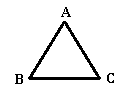
Similar Triangles: Two triangles are said to be similar if
(i)Their corresponding angles are equal and
(ii) Their corresponding sides are proportional.
- All congruent triangles are similar but the similar triangles need not be congruent.
- Two polygons of the same numbers of sides are similar, if:
(ii) Their corresponding sides are in the same ratio.


Graph assignment class 9th
Graph assignment class 9th
Graph: Graph is one of the most appealing and convincing ways of presenting the data, because graphs are good visual aids and make unwieldy data easily intelligible. There are various methods of graphical representation.

Class 11th Kinematiampcs (assignment)
Kinematics
(Assignment for Practice)
Kinematics is a branch of classical mechanics that describes the motion of points, bodies (objects), and systems of bodies (groups of objects) without considering the mass of each or the forces that caused the motion. Kinematics, as a field of study, is often referred to as the "geometry of motion" and is occasionally seen as a branch of mathematics. A kinematics problem begins by describing the geometry of the system and declaring the initial conditions of any known values of position, velocity and/or acceleration of points within the system. Then, using arguments from geometry, the position, velocity and acceleration of any unknown parts of the system can be determined. The study of how forces act on masses falls within kinetics.


Class 12 th Physics Current Electricity Assignment
Electric Current
An electric current is a flow of electric charge. In electric circuits this charge is often carried by moving electrons in a wire. It can also be carried by ions in an electrolyte, or by both ions and electrons such as in an ionised gas (plasma).
The SI unit for measuring an electric current is the ampere, which is the flow of electric charge across a surface at the rate of one coulomb per second. Electric current is measured using a device called an ammeter.
Electric currents cause Joule heating, which creates light in incandescent light bulbs. They also create magnetic fields, which are used in motors, inductors and generators.


Heron's formula class 9th assignment
Heron's formula (sometimes called Hero's formula), named after Hero of Alexandria, gives the area of a triangle by requiring no arbitrary choice of side as base or vertex as origin, contrary to other formulas for the area of a triangle, such as half the base times the height or half the norm of a cross product of two sides.


Class 10th Arithmetic Progression, practice assignments-1
Arithmetic Progression (AP)
An arithmetic progression (AP) or arithmetic sequence is a sequence of numbers such that the difference between the consecutive terms is constant.
For instance, the sequence 5, 7, 9, 11, 13, 15, . . . is an arithmetic progression with common difference of 2.
- Sequence: A sequence is a succession of numbers or terms formed according to some rule.
- Terms: The elements in a sequence are called Terms. A sequence is generally written as <an> where an known as nth term of the sequence or general term of the sequence. a1 , a 2 , and a3 ... are first, second and third terms ... of the sequence.
- Finite sequence: A sequence containing finite number of terms is called a Finite sequence.
- Infinite Sequence: A sequence having unlimited number of terms is known as an Infinite sequence.


Class 10th arithmetic progression assignment for practice
Arithmetic Progression-AP
(Assignment for practice)
An arithmetic progression (AP) or arithmetic sequence is a sequence of numbers such that the difference between the consecutive terms is constant.
For instance, the sequence 5, 7, 9, 11, 13, 15, . . . is an arithmetic progression with common difference of 2.


Class 12th NCERT very important questions of inverse trigonometry
Inverse Trigonometry
The inverse Trigonometric Functions (occasionally also called arcus functions, antitrigonometric functions or cyclometric functions) are the inverse functions of the trigonometric functions (with suitably restricted domains). Specifically, they are the inverses of the sine, cosine, tangent, cotangent, secant, and cosecant functions, and are used to obtain an angle from any of the angle's trigonometric ratios.


Class 12th formulas used in Inverse Trigonometry
Inverse Trigonometry
The inverse trigonometric functions (also called arcus functions,antitrigonometric functions or cyclometric functions) are the inverse functions of the trigonometric functions. Specifically, they are the inverses of the sine, cosine, tangent, cotangent, secant, and cosecant functions, and are used to obtain an angle from any of the angle's trigonometric ratios.


Class 11th straight line assignments
Lines: A geometrical straight line is a collection of points and extends endlessly in both the directions. A straight line drawn on a sheet of paper with the help of a ruler and a sharp pencil is an example of a geometrical straight line.

ASSIGNMENTS OF STRAIGHT LINES CLASS XIth


Class 12th maxima &; minima important questions
Maxima & Minima
Maxima and Minima (the respective plurals of maximum and minimum) of a function, known collectively as Extrema (the plural of extremum), are the largest and smallest value of the function, either within a given range (the local or relativeextrema) or on the entire domain of a function (the global or absolute extrema).Pierre de Fermat was one of the first mathematicians to propose a general technique, adequality, for finding the maxima and minima of functions.


Class XII Differentiation
Differentiation
The differentiation of trigonometric functions is the mathematical process of finding the derivative of a trigonometric function, or its rate of change with respect to a variable. Common trigonometric functions include sin(x), cos(x) and tan(x). For example, the derivative of f(x) = sin(x) is represented as f ′(a) = cos(a). f ′(a) is the rate of change of sin(x) at a particular point a.


Subscribe to:
Posts (Atom)